Does the Bayeux Tapestry identify Count Eustace II of Boulogne as Harold's killer?
Blogpost by Andrew Bridgeford 01.10.2026 www.andrewbridgeford.com
Author, 1066: The Hidden History of the Bayeux Tapestry
1 October 2026
As we approach the anniversary of the death of King Harold at the battle of Hastings on 14 October 1066, I want to highlight and explore again the argument in my book that Count Eustace II of Boulogne is cryptically identified as Harold's killer, striking him by sword on the thigh.

The arrow in the eye
In Chapter 15, and in the new Postscript, I examine the famous arrow-in-the-eye scene. As many historians have pointed out, the image seen today is the product of restoration in the nineteenth century and we cannot be certain that it reflects the Tapestry's original appearance. There is, however, one piece of early evidence of the Tapestry's appearance which is sometimes overlooked. This is a poem written in about 1100 by Baudri of Bourgueil (Adelae Comitissae). Baudri describes an imagined Tapestry which includes scenes which, on analysis, appear to follow quite closely the equivalent sequence of scenes in the actual Bayeux Tapestry. Mny have concluded that it is plausible to conclude that Baudri must have seen the real thing and based his own poem on it – and when we come to Harold's death Baudri tells us that Harrold was killed by an arrow (without specifying where the arrow hit). I look at the significance of this in the book and in new Postscript and will be returning to it in a separate blog.
In the present blog I concentrate on the scene which immediately follows. This shows Harold being struck on the leg by a horseman wielding a sword – a horseman usually taken to be some anonymous "Norman knight". It is one of the most intriguing scenes in the whole work.
The sword to the thigh
I contend that the Tapestry often deliberately gives us multiple accounts of the same events. The death of Harold is no exception. And I propose that what we see here contains visual indications identifying Harold's assailant as Count Eustace II of Boulogne.
Hardly a household name today, Eustace's significance at Hastings was also downplayed or ignored by Norman chroniclers. He was not a Norman. Rather he was Duke William's foremost ally at the time from northern France. Their dealings were not always friendly but in 1066 Eustace of Boulogne decided to support William of Normandy's claim to the English throne and take part in the invasion. Famed as the noblest heir of Charlemagne, he led a sizeable force of French knights which fought on the right flank at Hastings.
A contemporary written account states that Eustace killed Harold. This is the very earliest written account of the battle, the Carmen de Hastingae Proelio (Song of the Battle of Hastings). It was written c. 1068 by Eustace's kinsman, Bishop Guy of Amiens. Like the Tapestry, and unlike the Norman account, it treats Eustace as a hero of the battle. The Carmen is not a Norman source, but rather distinctively northern French. The Carmen comes at a time when Eustace was seeking to regain William's favour after falling out with the Normans not long after the victory and Eustace's unsuccessful attempt in 1067, in alliance with Anglo-Saxon rebels, to seize Dover castle from William's half-bother Bishop Odo of Bayeux. It thus seems to remind William of Eustace's important contribution at Hastings.
Also unlike the early Norman sources, which do not tell us how Harold died, the northern French Carmen specifically tells us that Harold was hacked to death by four men, one of whom was Count Eustace of Boulogne; another is Duke William himself (1). There is no mention of any arrow.
In a new Postscript I add more to the argument that the Tapestry's artist has ingeniously likewise identified Count Eustace as the man who kills Harold. As I note, the details of the blow inflicted by Eustace according to the poem are different from what we see in the Tapestry (2). Nevertheless the various clues left by the artist that Eustace of Boulogne is Harold's killer are exceptionally intriguing, even considering them individually but especially so when they are considered collectively.
Background to the argument: Eustace's earlier appearance
In the Tapestry Count Eustace appears by name as a heroic figure earlier in the battle. This is in stark contrast to the chief Norman source for the battle, the Gesta Guillelmi of William of Poitiers, which describes him as a coward.
Eustace is shown pointing with one hand to William, as the Norman Duke raises his visor in order to dispel a rumour that he has been killed, and with the other Eustace carries the largest banner in the Tapestry and gestures to the onward fight toward victory. Eustace is in fact William's only secular companion named during the battle scenes and is positioned right next to the Duke. William's only other named companion in battle is his half-brother Bishop Odo of Bayeux, seen on his other side, riding amidst the young knights and urging them on.
The stress of the Tapestry is therefore on the three of them acting in alliance: Odo, William and Eustace.
As noted above, only a year after the battle of Hastings, Count Eustace fell out violently with Duke William and Bishop Odo of Bayeux. Eustace and a raiding party of his French knights joined up with Anglo-Saxon rebels in an unsuccessful attempt to seize Dover castle from Odo. Several were killed on both sides (3). As a result of this debacle Eustace forfeited whatever share of the spoils he was due to receive. Normandy and Boulogne nevertheless managed to reconcile in the early 1070s. I argue that the reconciliation between William, Odo and Eustace in the early 1070s, although long overlooked in Tapestry studies, is absolutely fundamental for a proper understanding the work.
In short, I argue that, by portraying them as key allies at Hastings, the Tapestry acknowledges and celebrates the settling of differences between Eustace and the Normans, and in particular Bishop Odo of Bayeux, in the early 1070s.
I further argue that this is seen from the perspective of St Augustine's abbey in Canterbury, where on art-historical evidence historians have long considered the Tapestry to have been designed. Both Odo and Eustace appear to have been benefactors of the abbey and Eustace, moreover, was the abbey's nearest continental neighbour. Like Odo, he held great power and wealth as well as having the advantage, in the eyes of contemporaries, of prestigious Carolingian ancestry.
Against the theory that Bishop Odo commissioned the Tapestry I argue in the new Introduction that it can more plausibly be seen as a collaborative project between St Augustine's abbey (which provided the artist and can be seen to be promoting its own interests) and Queen Edith, Harold's sister and Edward the Confessor's widow. Edith may well have provided the embroiderers, including herself as she was a skilled embroiderer. Having accepted William's rule, she had reason to record a respectful account of her brother Harold, such as we can see in the Tapestry, but nevertheless an account which ultimately affirmed William's victory as God-given (4).
Eustace's name in the earlier battle scene has been partially damaged or defaced so that all we see today is E . . . TIUS (which should give us EUSTATIUS) and even the E is not entirely clear.
For reasons which I explain in the book the man beneath the damaged lettering is, on a strong balance of probability, Count Eustace II of Boulogne. My argument in favour of Eustace is supported by perhaps the leading authority on medieval Boulogne, Professor Heather Tanner (5). I shall return to the identification of Eustace in a separate blog.

Count Eustace as Harold's killer
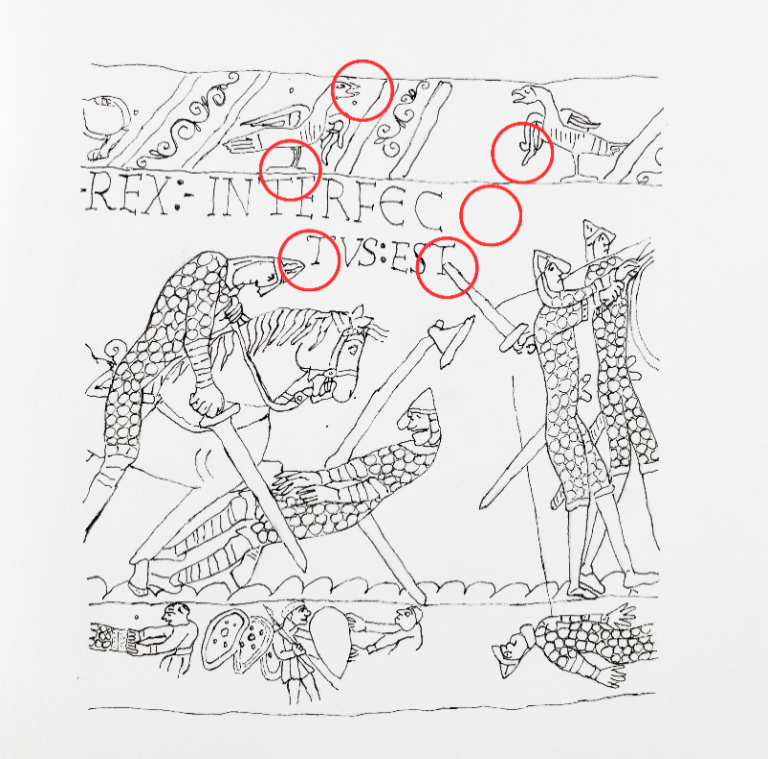
In Harold's death scene, there are six separate clues indicating that the controversial Count Eustace of Boulogne, the erstwhile enemy of Bishop Odo of Bayeus, makes a second cryptic appearance as the man killing Harold. There are several remarkable things about this scene: they arise from the way in which the famous words HIC HAROLD REX INTERFECTUS EST (Here King Harold was killed) are presented to the viewer.
The word INTERFECTUS has been unnecessarily broken in two. Although there would have been ample space to continue the sentence, the letters TUS:EST have been curiously detached. They are sited in a lower position.
The head and helmet of the man slaying Harold is bent over so that it is horizontal, and the tip of the helmet points us from the left specifically to the letters TUS:EST.
From the other side, the tip of an Anglo-Saxon sword also points us specifically to those letters, so that they are framed and highlighted on both sides by pointing devices.
Two birds in the upper border are now speaking excitedly to each other. The first points with its wing at the man slaying Harold.
The second draws our attention with its wing to the empty space vacated by the unnecessary displacement of TUS:EST.
These clues are then drawn together by the claws of the first bird. They stretch over the letters TE (in the remaining part of INTERFECTUS) in the manner of a curved mark of abbreviation. A curved mark over letters was a common general device in medieval writing in order to indicate an abbreviation. By alerting us to the fact that TE is an abbreviation in its avian mind, and by specifically pointing with its wing to the letters below, the bird is further telling us to pay the utmost attention to the letters TUS:EST.
Reversing the two triplets of TUS:EST we get EST:TUS which can be then read as an abbreviation of Eustace's name in Latin, Eustatius.
It is, in the artist's conception, the secret language of the birds that unpacks this riddle and reveals the identify of Eustace as Harold's killer. A common belief was that birds held special wisdom and knowledge which they expressed in their own secret language (6). Birdsong was sometimes called "their Latin" because it was only the very learned and initiated could understand it. Thus, in the twelfth-century French Roman de Thebes, Archbishop Amphiarax is said to have learned the birds' "Latin" in order to access their secret knowledge. The Tapestry's artist is playfully alluding to these kinds of belief in order to get his cryptic message across. His birds are presumably supposed, in a merely allegorical sense, to have been flying over the very battle as it happened, observing the great noise and the terrible slaughter, and to have been secret witnesses to Harold's death.
In the new Postscript I add more to the argument.
Referring to a much earlier scene during the Breton campaign I draw attention to a similar interaction between mythical animals in the upper border and the letters below which seem also to suggest another allusion to the name Eustatius. I won't repeat that here.
There is, however, another scene in which a similar device is apparent. I do not refer to it specifically in the new Postscript and I therefore take the opportunity to do so now. A minor Norman knight seen and named as Vital is shown in the scenes which lead up to the battle of Hastings. He is depicted as a scout who is asked by William if he has seen Harold's army (as I discuss n the book, we now know that when the Tapestry was made Vital had become a lay brother of St Augustine's abbey in Canterbury and this connection to the place of design may well have more significance for understanding the artwork than Vital's connection to Bishop Odo of Bayeux).

What we see here is the same use of posture and positioning of birds in the upper border in order to designate letters carrying a special meaning.
The bird in the upper border above Vital strains down with its long neck in order to designate Vital by touching or pecking at the tip his helmet.
The bird's claws then align over the letters VI in the word VIDISSET (has seen).
At the same time the similar but immediately preceding bird in the upper border designates, both with its claws and its beak, the two letters AT, which come at the end of the word INTERROGAT (asks).
Rearranging the letters AT and VI we get VITA; the two birds thus playfully point to an abbreviation of Vital's own name. Vital is expressly designated by name so there is no need for this cryptic reference. The allusion seems either merely playful or else another indication of the kind of operation that must later be performed on the letters TUS:EST when we come to the death of Harold.
The final evidence I draw on in the new Postscript is the similar learned and clerical wordplay with the name Eustace that we find in Lambert of Ardres' History of the Counts of Guines and Ardres (7). Lambert, though writing more than a century later, was referring to a Count Eustace of Guines who was a neighbour and cousin of Count Eustace of Boulogne. He cleverly subjects the name 'Eustace' to two puns involving Latin and (in the second occasion) also Greek whereby it becomes respectively "esto tuis" and "eu-status" – puns which are not so very far removed from my own decryption of TUS:EST and its reversed form of EST:TUS as standing for the name "Eustace" too. I explain all this in some detail in the new Postscript.
It is also interesting (but coincidental) that Count Eustace II of Boulogne is part of the "holy" family which is at the centre of Dan Brown's The Da Vinci Code and related pseudo-history. This is something to which I also devote a section in the new Introduction.
Footnotes
(1) The Carmen de Hastingae Proelio of Guy Bishop of Amiens, ed. F. Barlow (Oxford, 1999).
(2) The Carmen tells us that Eustace beheaded Harold and that it was Gilfard or Giffard who struck him on the thigh. A beheading (beneath the word Harold) is in fact shown in a scene just before the arrow scene. A separate argument in the new Postscript is that the Tapestry illustrates at least two of the ways Harold died according to the Carmen and possibly all four.
(3) The Gesta Guillelmi of William of Poitiers, ed. R. H. C. Davis & M. Chibnall (Oxford, 1998), relating this event in detail.
(4) My theory that the Tapestry reflects the interests, personnel and perspective of St Augustine's Abbey is shared with Pastan and White, The Bayeux Tapestry and its Contexts: A Reassessment (Boydell & Brewer, 2014). In additionally proposing Edith's role, I draw especially from Carola Hicks, The Bayeux Tapestry: The Life Story of a Masterpiece (Vintage, 2008).
(5) Heather Tanner, Families, Friends and Allies: Boulogne and Politics in Northern France and England, c. 879–1160 (Brill, 2004), p. 250.
(6) See Jenny Benham, "'A Little Bird Told Me … '. Spies and Espionage in the Norman World", Anglo-Norman Studies, 46 (2023), ed SD Church, 185–202.
(7) The History of the Counts of Guines and the Lords of Ardres, translated into English with an introduction by Leah Shopkow (Philadelphia, 2001). The puns are explained by Professor Shopkow, p. 218.
Comments